Kylian Mbappe has made history by becoming the first player to win the World Cup Golden Boot twice, securing the award for the top scorer at the 2026 tournament. The France forward scored 10 goals across eight games, surpassing Lionel Messi in the competition.
Mbappe previously claimed the Golden Boot at Qatar 2022, where he scored eight times, marking back-to-back wins of the prestigious award. His performance in 2026 also saw him become the first player to reach double figures for World Cup goals since Gerd Muller in 1970.
Only Just Fontaine, who scored 13 goals for France in 1958, and Hungary’s Sandor Kocsis have achieved more individual goals in a single tournament. Mbappe is now also the men’s World Cup all-time top scorer with 22 goals, moving one ahead of Messi.
Mbappe’s achievement was highlighted by two goals in the bronze medal match, though France ultimately lost 6-4 to England, finishing fourth. Following the match in Miami, Mbappe commented on his individual success, stating he would have preferred to play in the final rather than be the top scorer.
His goals during the tournament included strikes against Senegal and Iraq in the group stage, as well as against Sweden in the last 32. He also scored against Paraguay in the last 16 and against Morocco in the quarter-finals.
Messi, who ended the tournament with eight goals in as many matches, had the opportunity to overtake Mbappe in the final. However, the Argentina player did not score in New Jersey as his team was defeated 1-0 by Spain.
Other notable scorers in the tournament included England’s Jude Bellingham and Erling Haaland of Norway, both with seven goals. France forward Ousmane Dembele and England captain Harry Kane each scored six goals.
Spain’s Dominance in Individual Awards
World champions Spain secured most of the other individual awards. Captain Rodri was awarded the Golden Ball as the tournament’s best player. The Manchester City midfielder was a crucial part of Spain’s successful run to their second men’s World Cup title.
Rodri, received the Golden Ball from Fifa president Gianni Infantino at the MetLife Stadium in New Jersey after the final. This award marks his third major individual accolade, having previously won the Ballon d’Or in 2023 and the Uefa Euro 2024 Player of the Tournament.
Messi received the Silver Ball as the second-best player, while Mbappe was named the Bronze Ball winner.
Unai Simon, Spain’s goalkeeper, earned the Golden Glove award for best goalkeeper, having conceded only once in eight games. The Athletic Club stopper maintained seven clean sheets throughout the tournament, with his only conceded goal coming against Belgium’s Charles de Ketelaere in the quarter-final.
Simon, was chosen over Arsenal’s David Raya as Spain’s primary goalkeeper, justifying manager Luis de la Fuente’s decision with consistent performances as Spain became champions.
Emerging Talent and Records Broken
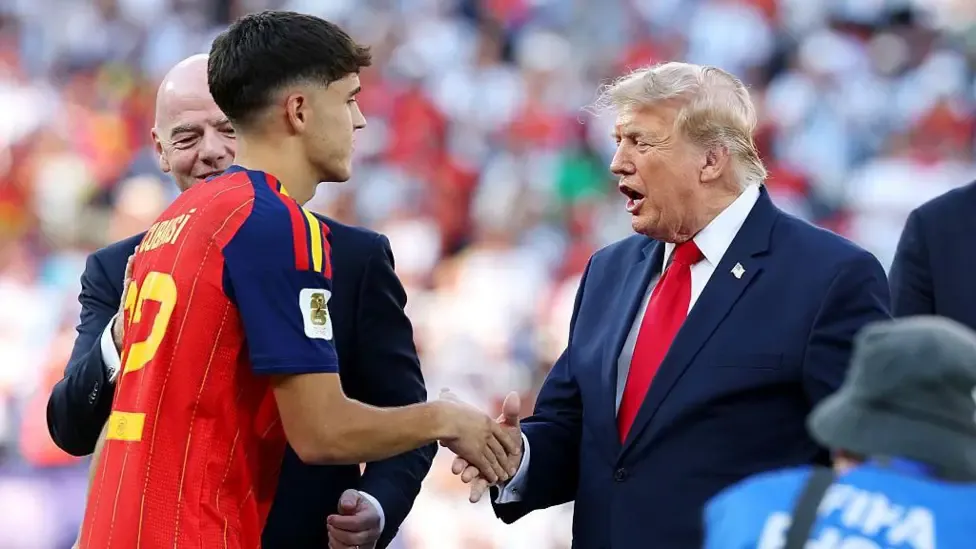
The award for the tournament’s best young player went to Pau Cubarsi, the Barcelona centre-back. Cubarsi played a significant role in the Spanish defence, which conceded only once during the entire tournament and limited Argentina to just two shots in the final, none of which were on target.
Cubarsi played every minute for Spain, contributing to their success which mirrored their 2010 World Cup victory in South Africa. Several other records were also broken during the tournament.
Miroslav Klose began the tournament as the all-time leading scorer in World Cups with 16 goals, but both Messi and Mbappe surpassed the former Germany striker. Haaland became Norway’s leading goalscorer at World Cups after only two games. Kane surpassed Gary Lineker as England’s top World Cup scorer, and Bellingham’s total of seven goals was the highest by an England player in a single World Cup.
Messi and Cristiano Ronaldo both participated in their sixth World Cup tournaments. Ronaldo became the first player to score in six World Cups and also the oldest player to score multiple goals in a game. The tournament also saw Curacao become the smallest nation to appear at a World Cup, and the match between Mexico and South Africa recorded the most red cards in an opening match with three.
The 2026 World Cup also marked the most-attended and highest-scoring World Cup in history, with the final taking place on Sunday, 19 July 2026.
Read Also
Source: bbc.com
