Lionel Messi has described the pain of Argentina‘s World Cup final defeat to Spain as “immense,” stating that the wound will require time to heal. Spain secured their second world championship title with a 1-0 victory, thanks to a goal from Ferran Torres in extra time. This result brought an end to Argentina‘s reign as champions, a title they had held since 2022.
For Messi, this marks his second World Cup final loss, having previously experienced defeat in 2014 when Argentina were beaten by Germany. At 39 years old, his participation in the 2030 tournament appears unlikely, though he has not yet made a definitive statement regarding his international career.
Messi’s Reflection on the Defeat
In a social media post, Messi shared his feelings, acknowledging the profound pain but also reflecting on positive aspects of their journey. He highlighted the team’s resilience in turning around matches and the enduring memories created. He also spoke of the unwavering support from their country, which, combined with the team’s dedication, helped them return to the elite level of world football.
Messi noted the difficulty in fully appreciating their achievement immediately after the loss, but emphasised that the team reached two consecutive World Cup finals. He extended his gratitude for the messages of support, stating that the team once again united the country and allowed them to share in the immense pride of being Argentine. He also offered congratulations to Spain on their championship victory.
Throughout the tournament, Messi played a crucial role, contributing eight goals and four assists as Argentina advanced to the final for the third time in four World Cups. He was instrumental in guiding his team through comeback victories against Egypt and England in the knockout stages. However, they were ultimately unable to overcome a formidable Spain side that conceded only one goal throughout the entire competition.
Spain’s Celebrations in Madrid
Meanwhile, Spain‘s triumphant return to Madrid was met with widespread celebration. Nearly two million people gathered in the city to welcome the national team home. The team, known as La Roja, arrived at Madrid‘s Barajas airport on Monday afternoon, receiving a hero’s welcome.
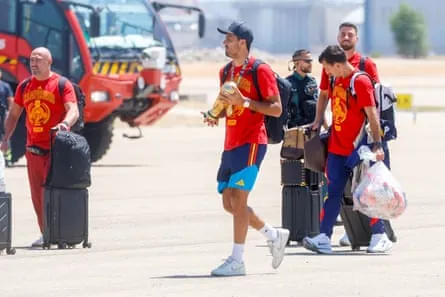
Rodri, Spain‘s captain, was seen waving the trophy as he disembarked the plane, his medal from the final still around his neck. The team posed for photographs before proceeding into the terminal, where hundreds of enthusiastic fans, many adorned in Spain‘s colours and carrying the rojigualda flag, eagerly awaited a glimpse of the newly crowned champions.
The team’s itinerary included an audience with King Felipe, Queen Letizia, and their daughters, Princess Leonor and Princess Sofía, at the Zarzuela palace. The King commended their talent and determination, describing their victory as an “epic triumph” and a privilege to witness. He also acknowledged the team’s fortitude, noting their suffering and criticism endured, which was ultimately overshadowed by the joy of bringing the cup home.
Following their visit to the royal family, the team met with Prime Minister Pedro Sánchez at the Moncloa palace. Sánchez expressed his profound gratitude for their performance, effort, and victory. Speaking at the palace, Rodri articulated the profound significance of winning for one’s country, remarking that this generation grew up watching previous champions lift the cup and that achieving it themselves was the greatest accomplishment in football.
Victory Parade and Public Reaction
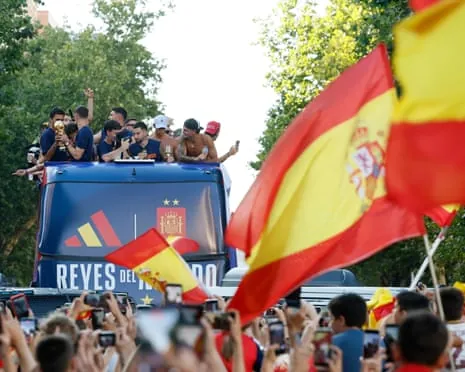
The highlight for the fans was the victory parade, which commenced from Moncloa and concluded at the Plaza de Cibeles, near Madrid city hall. Despite the warm evening temperatures, crowds estimated at around 1.8 million lined the route as the team travelled in an open-topped bus. The mayor of Madrid, José Luis Martínez Almeida, noted the peaceful and joyous atmosphere that characterised the celebrations following Spain‘s victory.
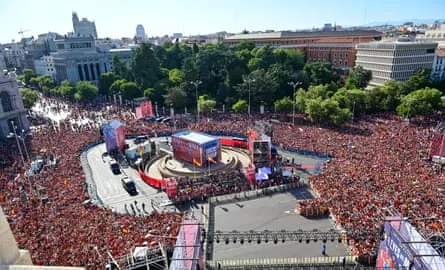
This victory marks Spain‘s second men’s World Cup title, following their triumph in 2010. The match was watched by hundreds of thousands across Spain in various public venues. The Spanish press has lauded the win as a “unique collective experience,” attributing it to a young team that embodies the best qualities of a modern, diverse, and determined nation. Political figures also offered their congratulations, with Prime Minister Sánchez and opposition leaders praising the team’s achievement.
To commemorate this historic event, the Spanish postal service, Correos, has announced the creation of a special red-coloured stamp. The stamp will feature the word CAMPEONES and two stars, symbolising Spain‘s two World Cup victories.
Read Also
Source: bbc.com
