Miami’s weather conditions
England are set to face Norway in a World Cup quarter-final match in Miami, where players will contend with significant heat and humidity. The match, scheduled for Saturday with a 22:00 BST kick-off, could see conditions that the global players’ union, Fifpro, considers potentially unsafe for play. The US National Weather Service (NWS) has issued a “hazardous heat threat” warning for Miami, indicating an increased risk of heat-related illnesses.
Air temperatures are projected to be around 33C (91F), but with humidity, the perceived temperature could reach approximately 41C (106F). The NWS had a heat advisory in place for Friday, and a similar advisory is anticipated for the weekend. There is also a possibility of thunderstorms, particularly near the start of the match, and scattered showers, though sunny periods are generally expected.
Sporting bodies like Fifa use the Wet Bulb Globe Temperature (WBGT) index, which factors in temperature, humidity, sunshine, and time. Fifpro’s guidelines suggest that a WBGT exceeding 28C should prompt delays or postponements. Calculations for Miami at kick-off indicate a WBGT between 28-30C. Despite these figures, there has been no indication that the match will not proceed.
The Hard Rock Stadium, where the game will be played, features an open design that, while shielding fans, may trap humidity on the pitch, limiting air circulation. Dr. Lee Taylor from Loughborough University noted that this environment could be a “humidity trap” where sweat, a primary cooling mechanism, struggles to evaporate effectively due to high water vapour pressure.
To mitigate the heat’s effects, Fifa has implemented measures such as climate-controlled benches, providing water and electrolyte drinks, ice, cold towels, fans, mist, and shaded areas. Players may also use phase-change ice vests before the match. During hydration breaks and at half-time, ice-cold water-soaked towels are considered more effective for cooling.
The two hottest matches in the group stage were both held in Miami. A 1-1 draw between Uruguay and Saudi Arabia saw a WBGT of approximately 32.9C, which was then surpassed by the 33C recorded during Uruguay’s 2-2 draw with Cape Verde six days later. The warmest game of the tournament occurred last Saturday, with Paraguay and France playing in Philadelphia at 37C, feeling closer to 44C due to a heatwave.
Team preparations and player perspectives
England‘s initial training base in the United States was in Florida, where Thomas Tuchel and his squad spent 10 days, including warm-up matches against New Zealand in Tampa and Costa Rica in Orlando. The team then moved to their tournament facility in Kansas, where daily air temperatures typically range from 32-34C (90-93F). Dr. Taylor emphasized the importance of acclimatization for player health and performance, suggesting that England’s consistent exposure to warm conditions in their bases means the players are likely acclimated.
In contrast, Norway played their two warm-up matches in cooler climates, against Sweden in Oslo and Morocco in New Jersey. However, they have experienced significant heat during the tournament, with their 2-1 victory over Brazil in New Jersey occurring under an NWS extreme heat warning, where temperatures reached 31C in the shade. Dr. Taylor noted that Norway has played several warm games, with the New Jersey match being particularly hot, and suggested that England’s acclimatization strategy might be more beneficial in terms of player fatigue.
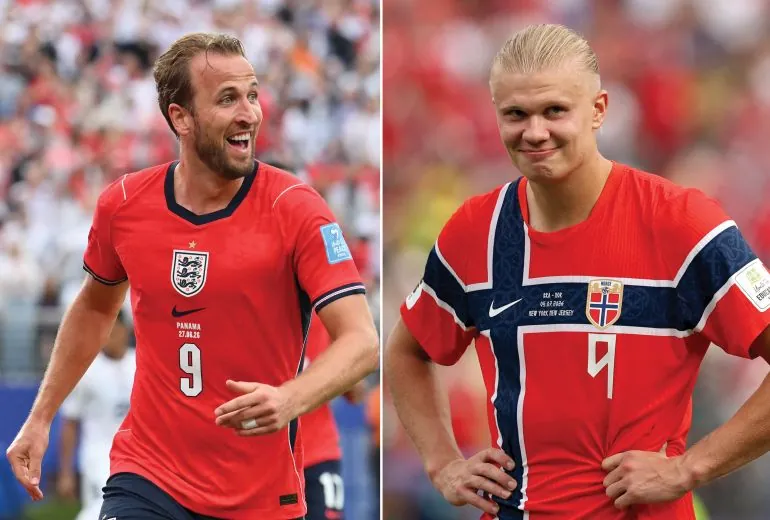
The quarter-final will feature a highly anticipated match-up between England captain Harry Kane and Norway‘s Erling Haaland. Kane described Haaland as “a machine” and a “beast” with an incredible goalscoring record, but highlighted their differences as players. Kane expressed that he prefers to be more involved in play, while also being capable of playing as an out-and-out number nine. He respects Haaland as a player and professional, hoping for a quiet day for him on Saturday.
Norway coach Stale Solbakken acknowledged that the contest between Haaland and Kane would be a deciding factor in the match, stating that both are their respective teams’ primary match-winners. Solbakken believes England faces more pressure, but also emphasized that Norway is focused on its own performance. He noted that this is Norway’s third “most important game” in the knockout rounds, having exceeded expectations by reaching the last eight for the first time in 26 years, including a 2-1 win against Brazil.
Jamie Carragher, a pundit, praised Haaland as potentially the “greatest goalscorer of all time,” predicting he could score over 1,000 career goals. Haaland has scored goals, including 62 in 54 matches for Norway. Carragher, however, stated he would prefer Kane in his team due to his more all-round contributions. He noted Haaland’s devastating presence in the penalty box and his physical dominance, describing him as a “man-mountain.” Carragher anticipates a narrow 2-1 victory for England but cautioned against underestimating Norway, citing their strong performance against Brazil.
Fan safety and future challenges
For supporters attending matches at the Hard Rock Stadium, there is a risk of heat exhaustion and heatstroke. Following the first three fixtures, the Miami-Dade Fire and Rescue reported 38 heat-related calls at the stadium, with five requiring hospital treatment. The City of Miami also reported 79 heat-related calls in one day at the Fan Fest on June 23.
Fans have been advised to use shuttle stations, which offer cooling sites, rather than walking long distances to the stadium. Dr. Taylor highlighted that the “final mile” to the stadium, often involving cordoned-off routes, can be particularly challenging. Simple advice for fans includes seeking shade, staying hydrated, carrying a refillable bottle, and wearing a wide-brimmed hat.
The team that emerges victorious from Saturday’s quarter-final will need to re-adapt for Wednesday’s semi-final match against either Argentina or Switzerland, which will be played indoors in Atlanta.

Kane, who won the World Cup‘s top goalscorer prize in 2018, aims to end England’s 60-year wait for a major trophy. He expressed that his main goal is to win the World Cup, recognizing that his goalscoring directly contributes to the team’s success. He also noted that this World Cup has been exceptional for top strikers scoring and influencing games. Solbakken noted that the entire country of Norway is looking forward to the match.
Read Also
Source: bbc.com
