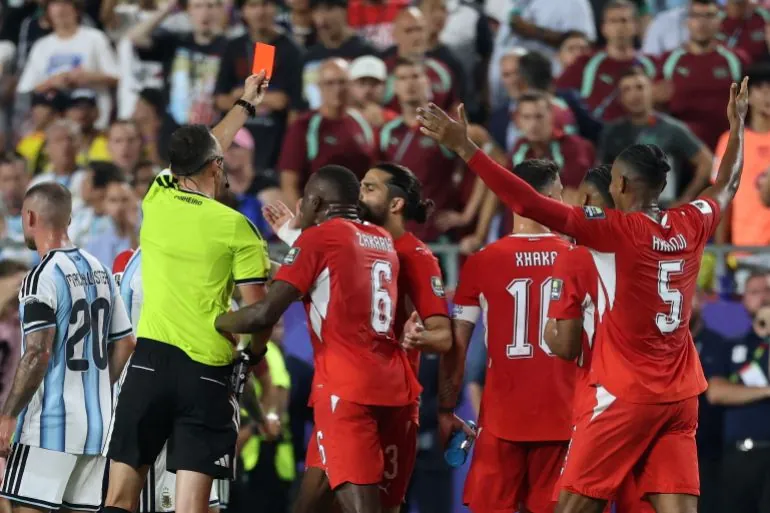
Switzerland’s Breel Embolo became the first player to receive a red card under the new mistaken identity rule during the current World Cup. The incident occurred in Kansas City during his country’s quarter-final match against Argentina, which ultimately saw Switzerland eliminated after a 3-1 defeat in extra time.
Embolo, who plays for French club Rennes, was initially booked in the first half. His sending off came in the 72nd minute after receiving a second yellow card for simulation. This decision followed a review by the Video Assistant Referee (VAR), which overturned an initial caution given to Argentina’s Leandro Paredes for what was first perceived as a clumsy challenge.
The VAR intervention directed referee Joao Pinheiro to the monitor, where a review led to the official deeming Embolo to have dived. The Swiss forward was visibly distraught as he was shown the red card, particularly as his team had just equalised against the reigning world champions five minutes earlier. Embolo, 29, left the pitch in tears, receiving consolation from his teammates.
Swiss coach Murat Yakin expressed strong disapproval of the decision. He stated there was no reason for a yellow card, describing the situation as harmless and suggesting play should have continued. Yakin criticised the rule as unacceptable and expressed that the intervention was unnecessarily hurtful, claiming it had nothing to do with football and ultimately destroyed their game. Despite the pain of the loss, he acknowledged they had to accept the outcome.
However, pundits watching the match offered limited sympathy for Embolo. Former Major League Soccer striker Bradley Wright-Phillips commented that he felt for Embolo’s teammates, but not for Embolo himself, suggesting the player might have cost his team a place in the semi-finals. Jobi McAnuff, a former Jamaica international, added that Embolo let himself and his teammates down, noting that while it was simulation, one could still feel some sympathy for him.
The new law, introduced by Fifa for the tournament, was specifically requested by Pierluigi Collina, the head of referees, to address mistaken identity. This rule allows for a decision to be changed if a player is booked or sent off, but the foul was actually committed by the opposition team. In this case, if Paredes had not been initially booked, the mistaken identity ruling would not have been applicable, and Embolo would have remained on the field.
The first instance of this law being applied earlier in the tournament involved USA defender Tim Ream. He conceded a free-kick and was shown a yellow card for what was initially believed to be a foul on Miguel Almiron. After the free-kick was taken, Dutch referee Danny Makkelie was sent to the VAR screen and subsequently overturned his original decision, which was a previously disallowed action for officials. Makkelie then rescinded Ream’s caution and instead booked former Newcastle United forward Almiron for simulation.
The incident involving Embolo began when Paredes was issued a yellow card for a foul on Embolo. The VAR team, operating remotely, identified the incident and called for a review. After consulting with the VAR team and reviewing replays, referee Pinheiro returned to the pitch to reverse Paredes’s yellow card and instead issued one to Embolo. Since Embolo had already received a booking earlier in the match, this second yellow resulted in his dismissal.
The International Football Association Board (IFAB), which governs the laws of football, classifies mistaken identity as a “match-changing” error. Their definition specifies that it occurs “when the referee shows a yellow or red card but has clearly penalised the wrong player of either team for the offence in question.” The new VAR rules enable such mistaken identity issues to be detected and reviewed by the VAR team.
Before Embolo’s red card, the match was evenly poised, with the score at 1-1 and less than 20 minutes remaining in normal time. Although Switzerland managed to hold the score until the end of normal time, playing with ten men ultimately proved costly. They conceded two goals in extra time, leading to their elimination from the tournament.
The match saw Julian Alvarez score a breathtaking goal in the 112th minute, curling it into the top corner from just outside the penalty area. A late third goal from Lautaro Martinez secured Argentina’s 3-1 victory. This win sets up a semi-final clash against England, a match that will be shown live.
The controversy surrounding Embolo’s red card was a significant talking point, occurring shortly after Dan Ndoye had cancelled out Alexis Mac Allister’s opening goal. Footage from the VAR review confirmed that Embolo had dived after a challenge from Paredes. The VAR team in Dallas reviewed multiple replays, which indicated a lack of contact, leading to the conclusion that Embolo had thrown himself to the ground.
It was noted that given the location of the incident, far from goal and near the touchline, there appeared to be no obvious advantage to be gained from the dive. It is possible that Embolo anticipated contact from Paredes, who was approaching at speed, but the contact did not materialise, leading to his fall. Regardless, the consensus was that Embolo’s action constituted a dive.
FIFA’s guidance on the ‘mistaken identity’ rule does not restrict officials to interpreting it only for players of the same team. The rules state that if a referee penalises an offence but clearly misidentifies the player who committed it, only the identity of the attacker can be reviewed. Therefore, Pinheiro’s reversal of his original decision was deemed correct under these rules. The irony lies in the fact that if a yellow card had not initially been shown to Paredes, the incident could not have been reviewed based solely on Embolo’s dive, as a card was required to trigger the protocol.
Argentina’s path to the semi-finals has not been without challenges. The Swiss performance against Argentina provided encouragement for England, as Switzerland created numerous problems for the world champions. Switzerland frequently breached Argentina’s defence, highlighting a lack of control in midfield for Lionel Scaloni’s team. Even with an extra man following Embolo’s red card, Argentina’s performance was not entirely convincing.
The semi-final between England and Argentina promises to be a compelling match, marked by a deep-rooted rivalry that extends beyond football. The last encounter between these two nations was 21 years ago in Geneva, where England won 3-2 in a friendly. Lionel Messi, who was suspended for that match, will be facing England for the first time in his career. The match will take place on Wednesday.
Read Also
- World Cup: England Beat Norway Amidst VAR and Spidercam Controversies
- Miami: England advance to World Cup semi-finals after extra-time win over Norway
- Argentina defeats Switzerland in extra time to secure World Cup semi-final against England
- Dallas Stadium to host France versus Spain in World Cup semifinal clash
Source: bbc.com
