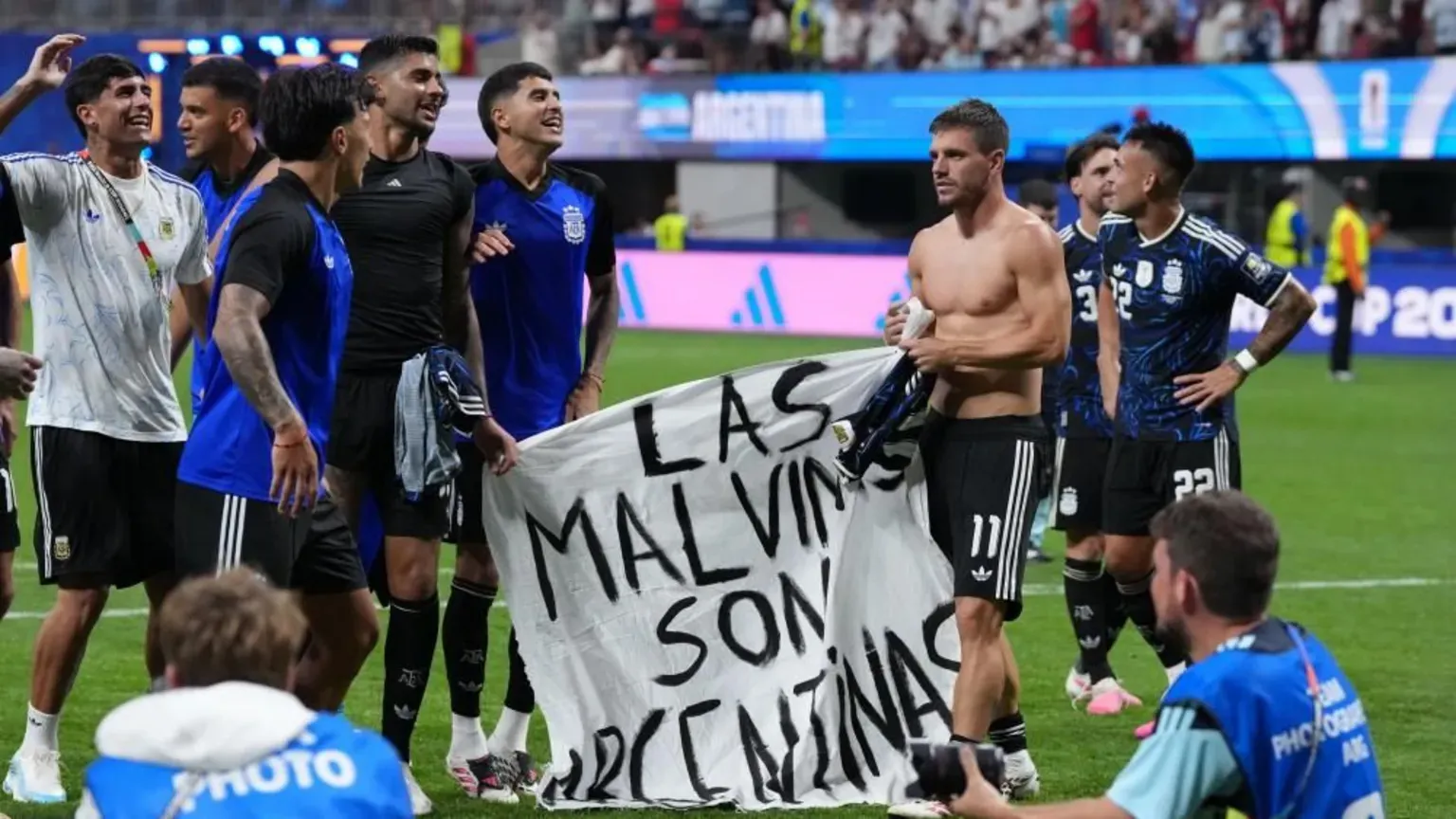
The White House has defended the Argentina national football team following their display of a banner supporting their country’s claim to the Falkland Islands. The incident occurred during celebrations after their World Cup semi-final victory against England.
Andrew Giuliani, head of the White House Fifa task force, stated on Friday that the team had the opportunity and right to express such statements in the United States. He referenced the US Constitution‘s free speech protections, noting, “We believe in our First Amendment rights here in the United States of America.”
This defence from the White House could intensify the ongoing controversy. Downing Street has supported calls for Fifa to investigate the incident. The Falkland Islands, a British overseas territory in the South Atlantic, remain a point of contention regarding sovereignty between the UK and Argentina.
Banner Display and Reactions
Following their semi-final match on Wednesday, Argentina players held a banner that read “Las Malvinas son Argentinas,” which translates to “The Falklands are Argentine.” This display has drawn significant attention and differing reactions.
A spokesperson for Downing Street commented on the situation, asserting, “The World Cup might not be ours, but the Falkland Islands definitely are. Our commitment to the Falklands will never waver.” They added that any potential action against the Argentina players was “a matter for Fifa,” while also echoing the sentiment that Fifa should investigate the matter.
The government of the Falkland Islands expressed disappointment but indicated they were not surprised by the banner. They hope that Fifa will “sanction all behaviour of this nature in line with its own rules.” A statement from the island government emphasised a desire to keep politics separate from sport and to prevent the islands and their inhabitants from being used as a “political football” in discussions concerning England and Argentina.
In 2013, a referendum saw the people of the Falkland Islands vote overwhelmingly to remain a UK overseas territory. Out of 1,517 votes cast, 1,513 were in favour of remaining a UK territory, with only three votes against, on a turnout exceeding 90%.
Argentina Vice-President Victoria Villarruel also commented on the issue after Wednesday’s victory, posting on X that “it wasn’t just another match.” Her post, which included a video appearing to show Argentine soldiers, reiterated, “The Falklands are Argentine. They banned bringing them to the stadium and forgot that we carry them in our blood and our hearts.”
References to the Falklands were also made in chants by Argentina players, alongside mentions of football greats Maradona and Lionel Messi, after their 3-2 win over Egypt in the last 16.
Historical Context of the Dispute
The sovereignty dispute over the Falkland Islands led to a brief but intense conflict between Britain and Argentina in 1982. Argentine forces landed on the islands to assert a territorial claim, which was met by a British military task force that ejected them.
The conflict lasted 74 days and resulted in the deaths of 255 British military personnel, three islanders, and 649 Argentine soldiers. Prior to the war, British governments had been engaged in negotiations with Argentina regarding the transfer of the islands’ sovereignty.
A 1971 communications agreement with Buenos Aires facilitated trade and travel for islanders with the adjacent mainland, providing access to hospitals, shops, and educational facilities. Hundreds of Argentinians visited Port Stanley as tourists, fostering relations from which a future settlement was anticipated.
The United Nations at the time encouraged former European colonial powers to address remaining imperial territories. For Britain, this included territories like Hong Kong, Diego Garcia, the Falklands, and potentially Gibraltar. The focus was on geographical common sense rather than historical claims.
A Labour Foreign Office minister, Ted Rowlands, visited the islands in the late 1970s to discuss extending the communications deal to a leaseback agreement, which would grant Argentina sovereignty while maintaining British governmental control. This proposal was inherited by the Thatcher government in 1979, and though the new minister, Nicholas Ridley, was authorised to pursue it, the 1982 invasion by the Argentine military halted these talks.
The 1982 war led to a freeze on discussions regarding the islands’ sovereignty for over 40 years. Despite the 2013 Falklands referendum, some suggest that these territories will eventually integrate with their respective continents, as they cannot be indefinitely protected by a European patron, and Argentina‘s claims persist.
The Foreign Office and defence ministry continue to address the issue, with some hoping that the recent banner display at the US football match might prompt renewed action.
Read Also
Source: bbc.com
