The total prize fund for the FIFA World Cup has seen a substantial increase, reaching a record $655 million for the 2026 tournament. This figure represents a significant expansion in payouts for the competition, which will feature 48 participating teams.
The 2026 edition, co-hosted by Canada, Mexico, and the United States, marks the highest prize pool in the tournament’s history. This increase includes more than $100 million that was added in April following lobbying efforts from some European federations. These federations sought assistance to cover the extensive travel and lodging costs associated with a tournament spread across three countries.
Increased Payouts for Teams
The World Cup winner earns $51 million. The second prize is $34 million. For perspective, the $51 million awarded to the champions surpasses the $42 million received by Argentina for winning the 2022 World Cup in Qatar.
All 48 national federations participating in the World Cup receive financial support from FIFA. This support comes in two categories: prize money bonuses based on how far each team advances in the tournament, and across-the-board payments to cover training and preparation costs.
Every team is guaranteed at least $12.5 million for competing in the World Cup. This amount includes $10 million in prize money for qualifying and playing in the group stage, along with $2.5 million allocated for pre-tournament training and expenses. This upfront payment structure was established in previous World Cups to help prevent pre-tournament disputes regarding unpaid bonuses to players by their federations.

The prize money increases as teams progress further into the competition. Teams reaching the quarter-finals each received $20 million, and those in the Round of 16 each took home $16 million. Teams in the Round of 32 received $12 million each, and group stage participants were awarded $10 million each.
Historical Growth of the Prize Fund
The total prize fund for the FIFA World Cup has shown consistent growth over the years. In the 2002 World Cup, co-hosted by South Korea and Japan, the prize pool was $134 million.
This figure rose to $236 million in Germany in 2006, and then to $348 million in South Africa in 2010. The upward trend continued in Brazil in 2014, reaching $358 million. By 2018 in Russia, the fund was $400 million, and in Qatar in 2022, it reached $440 million.
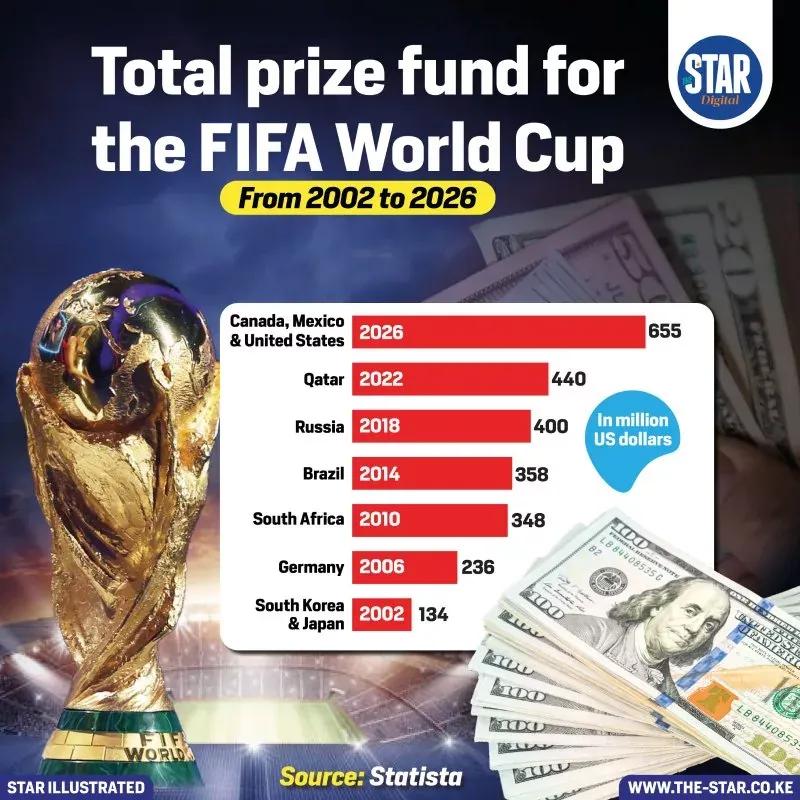
The significant jump to $655 million for the 2026 tournament, as reported by Statista, highlights the continued financial expansion of the global football event. This figure represents the highest payout recorded across the surveyed periods.
Financial Support Beyond Prize Money
Beyond the prize money, FIFA also provides additional financial support to participating nations. This includes covering business-class return flights for each delegation, as well as accommodation and meals for a 50-member delegation. This coverage extends from five days before a team’s opening match until one day after their elimination from the tournament.
FIFA also manages domestic transport during the competition, providing a fleet of official vehicles and an equipment truck. However, national federations are responsible for player and staff insurance, incidental hotel expenses, and accommodation for any additional delegation members beyond the allocated 50.
It is important to note that the World Cup prize money is paid directly to each national football federation, not to the players themselves. The distribution of these funds is determined by each federation’s internal rules and agreements with its players. For example, the United States Soccer Federation retains 20% of its World Cup prize money, with the remaining 80% shared equally between the men’s and women’s national teams under their equal-pay agreement.
Read Also
Source: the-star.co.ke
