Debate over World Cup expansion
The possibility of expanding the World Cup to include 64 teams has become a topic of discussion, even as the first 48-team tournament recently concluded. FIFA President Gianni Infantino indicated that the idea could be examined following the tournament’s final, prompting renewed debate about the future scale of football’s premier event.
This potential expansion would significantly alter the tournament’s structure. A 64-team format would result in 128 matches. This represents double the number played under the previous 32-team format.
The 2026 tournament, hosted across Canada, Mexico, and the United States, marked the first departure from the 32-team format since 1998, expanding to 48 nations and featuring 104 matches over more than five weeks.
Logistical and financial implications
Such an expansion would bring considerable logistical challenges, requiring more stadiums, hotels, and transport infrastructure. For instance, the 2030 tournament, planned to be largely staged in Spain, Portugal, and Morocco, with single opening-round matches in Uruguay, Argentina, and Paraguay, would face formidable organisational hurdles with 64 teams across six host nations.
The financial implications are also significant. A 64-team tournament could make qualification easier for many larger footballing nations, potentially diminishing the commercial value of qualifying competitions. This shift could increase the importance of FIFA’s flagship event while making regional confederations more reliant on FIFA’s financial distributions, thereby centralising more financial influence within the global governing body.
UEFA President Aleksander Ceferin has previously expressed opposition to further expansion, stating it is not beneficial for the World Cup itself or for qualifying competitions. Asian Football Confederation President Sheikh Salman bin Ibrahim Al Khalifa also raised concerns about the extent of future expansion.
Infantino, however, has highlighted the importance of global participation, stating that the World Cup should be organised for the entire world, not just Europe and South America. He suggested that providing smaller countries with the chance to participate offers an incentive for continued improvement in their football programmes.

A 64-team tournament would also intensify player welfare concerns due to an increased workload for elite players and place greater strain on the international football calendar. This could disrupt domestic leagues, many of which have aligned with Europe’s traditional August-to-May season.
The French Football Federation, for example, anticipated spending at this year’s World Cup, with its president, Philippe Diallo, noting that the national team would likely need to reach at least the semi-finals to avoid financial losses. An extended 64-team event could further increase these costs for participating federations.
Potential format changes and future decisions
The proposal for a 64-team World Cup would involve a complete overhaul of the tournament structure. This system would likely divide the opening phase into 16 groups of four teams, increasing the group-stage fixture list from 72 to 96 matches. Extending the competition to six weeks could lead to increased calendar conflicts with clubs, as players might need to commit up to two full months, including pre-tournament preparations.
CONMEBOL President Alejandro Domínguez recently claimed on social media that the 2030 World Cup would feature 64 participating nations. This assertion, made shortly after the 2026 tournament concluded, sparked widespread speculation, though FIFA has not yet made an official confirmation.
FIFA’s governing bodies are expected to hold a series of internal committee meetings to assess the feasibility of the proposed expansion. The decision on the competition format is anticipated to be formally announced at a future FIFA Congress.
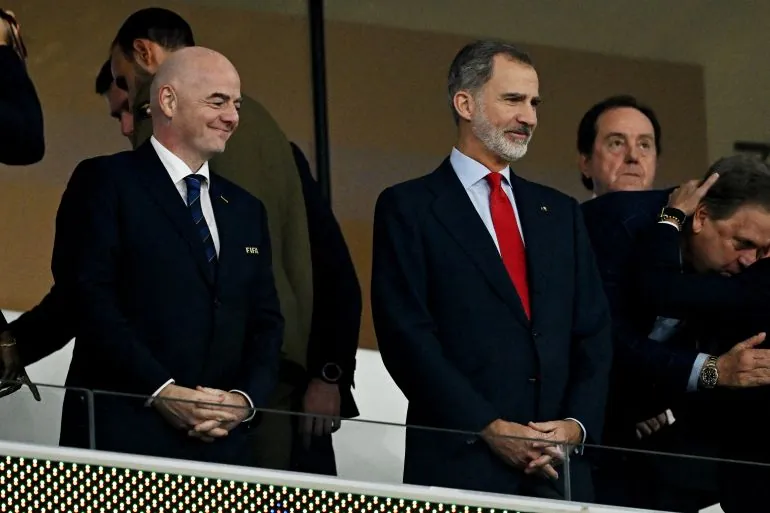
The success of the 48-team format has been highlighted by Infantino, who noted that teams from every continent scored goals and earned at least one point, with nine out of ten African teams reaching the knockout stage. This outcome, he suggested, demonstrates the importance of including more teams and providing them with opportunities to participate.
A 64-team format would magnify these challenges, requiring more infrastructure and resources in a country still developing its tourism industry.
The ultimate progression of the 64-team World Cup idea beyond discussion may depend on the final assessment of the first 48-team World Cup.
Read Also
Source: aljazeera.com
